“Floria Sigismondi once described her work as portraying ‘entropic underworlds inhabited by tortured souls and omnipotent beings’.”
-Sarah Badr, graphic designer.
I don’t think that Floria Sigismondi’s work could be described any better than what has been said here. Each word has a resonating emotional effect; ‘torture’, ‘entropy’, ‘omnipotent’. These all have strong, vivid connotations and emotional impact, which is reflected in Sigismondi’s work. I hadn’t previously considered the idea of entropy in her photos, but now, the more I think about it, the more I can see what Badr means. Sigismondi’s work, static and moving, has a very decayed feel to it. Not just the scenery, but the models too- they look run down, worn down, ready to give up, ruined, which is perhaps what lead to the description of “tortured souls”.
The use of “underworld” reflects my thoughts on her work exactly; Not once have I ever considered that there could be a blue sky and shining sun in any of her photos. Without even being specifically told that that’s where they are, I immediately assumed that they were not of this world, rather somewhere hidden away, below the surface.
This quote hasn’t greatly affected how I view Floria Sigismondi’s work; I’m still as entranced as I ever was by it, but it has opened up a few more avenues of thought to explore while looking at her photos.
Floria Sigismondi is perhaps most known for her work as a director. Her work is mostly music videos for recording artists, although she is working on a feature-length film at the moment. She’s been much in demand due to her distinctive and unique way of creating a moving piece of art to fit with a song, with clients like Marilyn Manson, The Cure, and David Bowie. Because of this prowess with the moving image, I’m focussing my attentions more on that as opposed to her photography.
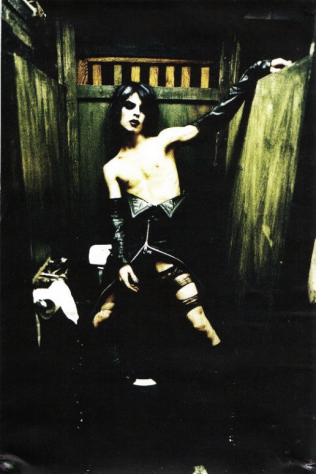
Untitled, Floria Sigismondi, 1997. Sigismondi’s book Redemption is comprised largely of stills from some of the videos she directed, and also a few photos she took on the sets, which obviously tie in with the videos, but are separate works in their own right. My favourite image from the book is one such photo which was taken on the set of Can’t You Trip Like I Do, (a song by Crystal Method) but which doesn’t actually feature in the video. It has the clean shine characteristic of the video, but the fact that it’s shot in a grimy toilet stall lends it that grimy, run-down look; a Sigismondi trademark. The model looks like he’s taunting the viewer, daring them to come closer. His stance is very assertive, making this quite a confrontational image. It’s quite interesting to note how, even though this model –ignoring the latex dress and ripped stockings- is essentially very normal looking, his body language is much more aggressive than that of the models’ in Sigismondi’s other, more bizarre works.
Tourniquet, by Marilyn Manson, directed by Floria Sigismondi, 1996
Tourniquet, by Marilyn Manson, was the first time I ever saw a Sigismondi-directed video, even though I didn’t know it was her work at the time. To me, it sums up what Sigismondi’s work is all about; dirt, entropy, shadow, decay, excess. It’s not quite like a nightmare, but it’s not exactly a pleasant dream either. A hallucination, maybe, brought on by mind-altering drugs. Either way, the edges of each frame are slightly fuzzy, lending an other-wordly atmosphere to what could’ve otherwise been just a very odd kind of party. The soft lighting adds to this; picks out some things and leaves others in shadow, falls delicately over Manson’s distorted face, creates a contrast between the disturbing imagery and the softness with which it’s presented. Looking at the video planning notes made by Sigismondi, included amongst the Tourniquet stills in Redemption, we can see that the video was originally intended to be shot through scraps of lacy fabric, most likely to add to the broken-down, antique feel to the video. Why this wasn’t done in the end, I don’t know. Perhaps because it would’ve interfered too much with everything else that was already going on in the video; it is, after all, already incredibly packed full of strange objects and people. Adding lace over the shaky, unfocussed and peculiarly-angled shots might have just made the video 4 minutes of indecipherable flashes and blurs.
However, as there is no lace to obscure the view, the somewhat unorthodox camera techniques only serve to enhance the images being shown. They bring about an extra sense of the unknown to what is already a very perplexing piece of film.
Can't You Trip Like I Do, by Crystal Method, directed by Floria Sigismondi, 1997 Can’t You Trip Like I Do, by Crystal Method, shows a different side to Sigismondi’s work. It’s a lot cleaner than some of her other videos, but certainly not lacking her distinctive artistic signature of dark and macabre imagery. This video employs a lot of modern-looking, electronic props, as opposed to videos like Tourniquet, which have a very old, antique feel. It is, evidently, somewhat of a departure from the norm for Sigismondi; the singer doesn’t even wear any extreme makeup or costume until the very last scene. It feels very modern, almost in a time that hasn’t yet passed. The quick succession of shots at the start lends itself well to the alien, futuristic, almost drug-addled atmosphere, and seems to reflect the title of the song itself. In terms of the quick shots, the video is somewhat reminiscent of Tourniquet, and although the shots serve much the same purpose, namely creating an extra enigma around what is already a weird and wonderful video, these ones are faster, seemingly with the aim to disorientate the viewer, to make them feel dizzy and drug-addled like the people in the video.
The lighting in this video works in mostly the same way as in Tourniquet; it picks out and hides people and props, but where it differs is that this lighting is extremely harsh. It goes well with the futuristic feel that this video has; a man hooked up to television screens wouldn’t look quite so intriguing were he lit softly, and from various flattering angles.
 Sigismondi’s book Redemption is comprised largely of stills from some of the videos she directed, and also a few photos she took on the sets, which obviously tie in with the videos, but are separate works in their own right. My favourite image from the book is one such photo which was taken on the set of Can’t You Trip Like I Do, (a song by Crystal Method) but which doesn’t actually feature in the video. It has the clean shine characteristic of the video, but the fact that it’s shot in a grimy toilet stall lends it that grimy, run-down look; a Sigismondi trademark. The model looks like he’s taunting the viewer, daring them to come closer. His stance is very assertive, making this quite a confrontational image. It’s quite interesting to note how, even though this model –ignoring the latex dress and ripped stockings- is essentially very normal looking, his body language is much more aggressive than that of the models’ in Sigismondi’s other, more bizarre works.