CINDY SHERMAN
“I want that choked-up feeling in your throat which maybe comes from despair or teary-eyed sentimentality: conveying intangible emotions.”
-Cindy Sherman
I agree with Cindy Sherman completely. I am of the opinion that if a photograph doesn’t evoke something, choked-up despair or otherwise, then it’s not worth being printed. The ultimate aim of art is, after all, to communicate an atmosphere, an emotion or an idea, and if the viewer is left unaffected then the artwork has failed in its purpose. I think that Sherman has got to the root of what separates a work of art from a simple snapshot; her work definitely has somewhat of an aura about it, like that of Floria Sigismondi’s. Not always the same aura, but an aura nonetheless. Sigismondi’s photos tend to have more sinister imagery, and while some of Sherman’s work can be quite sinister also, there is often a slightly tongue-in-cheek feel to it.
Having read this quote of Sherman’s has made me, if anything, like her work a little more. It’s evident from what she said that she feels strongly about creating a connection between photo and viewer, something that transcends merely observing an image. While I may not like every photo of hers, the ones I do like have taken on somewhat of a new meaning; the fact that her work is quite personal and has a deep connection with herself affects the way I feel about it, in that I feel like I have connected more with it, despite the image remaining unchanged.
The later work of Cindy Sherman has been described as visceral and disturbing, much like the work of Floria Sigismondi. The difference, however, lies in how they go about provoking these kinds of reactions; compared to Sherman, Sigismondi is quite soft and subtle. Sherman’s work can be very loud and brash, demanding to be looked at. She does have her softer moments (like, for example, Untitled #153, but the majority of her work after Untitled Film Stills makes up a portfolio which is quite hard to look at.
Sherman has only used herself or mannequins as models, from the Untitled Film Stills series up until her most recent works. This could be because, like Grekof, she doesn’t trust anyone else enough to properly convey what she wants, or perhaps she’s just intrigued as to how one face can be changed so much and look so different with the aid of some makeup and props. It could be simply that she’s always available and always able to do whatever is needed to get the shot. Whatever her reasons, her work certainly doesn’t lack in depth or variety. In fact, her work is some of the most genre-spanning of the three photographers I’m studying. Were you presented with, for example, Untitled Film Still #14 (view here), and Untitled #187 (view here), you would not automatically assume that they were by the same photographer.
Untitled #153, Cindy Sherman, 1985.
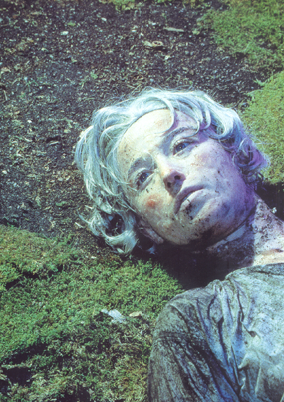 This photo reminds me very much of Sigismondi’s and Grekof’s work; it could have been taken by any one of them. It has the harsh reality of a Sherman photo- here’s a woman, she’s probably dead, let’s get nice and close; the meticulous detail of a Sigismondi photo- special effects makeup, dirtied dress; and the softness of a Grekof photo- the calm, almost serene look on the model’s face.
The cold colours, and the dirt covering the model, make me think of a river bank at 5am, murder victim carelessly thrown in the water and then washed up several hours later. It’s the quality of the light that makes me pinpoint it at 5am; something about the how it falls across her face and lights the ground reminds me of the weak sunlight of early morning. Showing only the head and shoulders leaves the state of the body open to interpretation, hinting at and at the same time hiding a potential evisceration.
Untitled #305, Cindy Sherman, 1994.
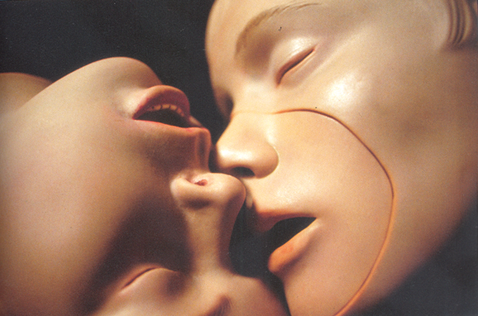
This photo has a sense of desperation about it. The faces of the mannequins almost look like they’re made of real flesh and blood, that their faces aren’t frozen in some arbitrary open-mouthed expression but are, in fact, feeling real emotions. I can’t decide if they’re lovers in the throes of ecstasy, or two corpses left to rot. Perhaps it’s both, a Romeo and Juliet type scenario. Either way, the sense of desperation would be fitting.